
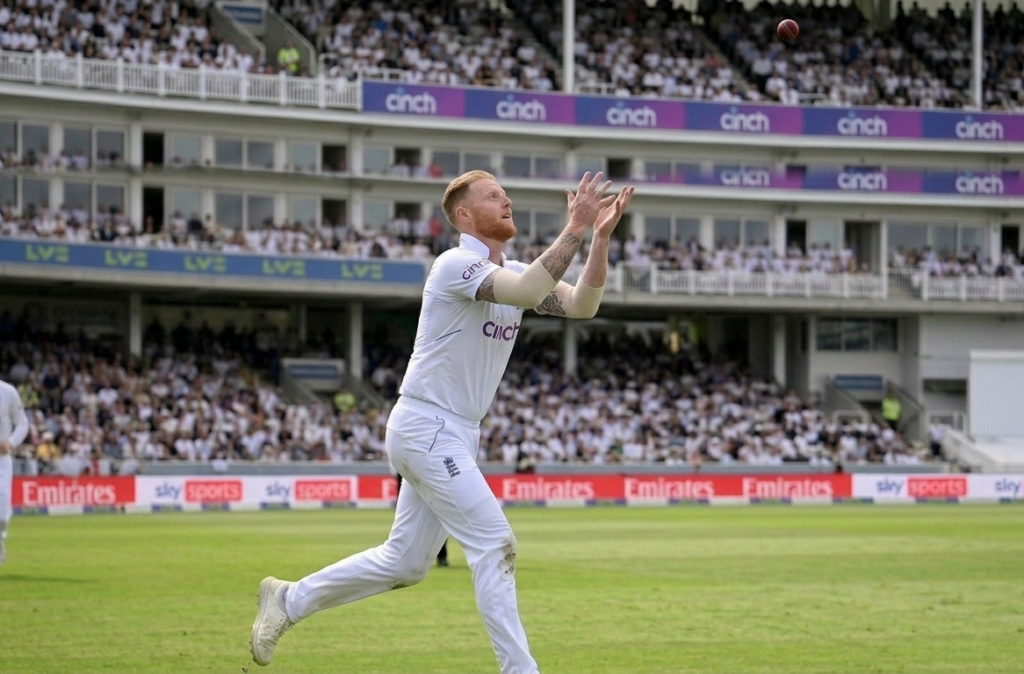
The test series between England and New Zealand ended with Ben Stokes announcing his retirement from international cricket smack in the middle of the final test match, with the result still hanging in the balance. New Zealand managed to crawl back and win the series 2-1 after losing the first test, but unsurprisingly, the retirement of two of the titans of the game of cricket dominated the headlines.
Kane Williamson and Ben Stokes were both modern greats, but could not be more different in personality than each other, even if they tried. Williamson is quiet, unassuming and likes to maintain a low profile. For Stokes, on the other hand, it is not a matter of seeking the spotlight, but of the spotlight tracking him down.
The public at the stadium had just been made aware of his retirement when he was in the middle of an exhausting eleven-over spell. No sooner had this happened than he picked up Foulkes’s wicket for the crowd, and even some of his teammates, to go wild.
Chasing 372 in the fourth innings, he opted to open and batted as if he had just received some ‘Seize the day’ message on his phone and literally took it to heart. Reverse sweep, dropped chance, muscled six, the innings had it all. It was chaotic and entertaining in equal measure. Had he bellowed out to the crowd, ‘Are you entertained?’ at the end of his innings, it would certainly not have been out of place.
A career that began with promise, then increasing volatility, finally settled down with Stokes blossoming into an outstanding match winner and inspirational leader, the events that led to his retirement were not a happy one. The final few months did not go according to plan. A drawn test series against an inexperienced Indian side was followed by a 4-1 hammering in Australia. His bowling continued to be exceptional, but there was a marked decline in his batting form.
Adding to this were multiple incidents with the players getting themselves into trouble, or simply managing to show up inebriated in front of a camera. World-class athletes getting wasted and then repeatedly losing matches is not a good look for any team. Coach McCullum’s remarks linking the initial losses to ‘over-preparing’ and dismissing some of the obvious issues within the team did not help matters. As the captain of the team, it all started affecting Stokes.
The final nail in the coffin was the incident on 8th June, just after England had defeated New Zealand in the first test. Stokes and Gus Atkinson had broken the team curfew to visit a nightclub in Chelsea, where an altercation between their security team and a rugby player ensued. While Stokes and Atkinson were not deemed to be the aggressors and were cleared of any serious wrongdoing, it led to both players being dropped from the next match. Some of the conversations Stokes had with the management also got leaked to the media.
The emotional and physical fatigue compounded by the recent events, and somewhere along the way, drained Stokes of his signature resolve. In his own words, he ‘did not have any more fight left’. For a player whose career almost ended with a late-night brawl in Bristol, something seemed to have been triggered. That incident in 2017 that led to his fight for redemption from scratch to finally become the world-class all-rounder of today was being relived all over again.
Controversy was nothing new to Stokes. His misadventures included obstructing police on duty during a night out in Newcastle and being sent back during a Lions tour to Australia for indiscipline. In 2014, after a string of low scores and getting frustrated, he broke his wrist after punching a locker, ruling himself out of the T20 World Cup. Clashes with opponent players did not help his image of being short-fused.
The four consecutive sixes he conceded in the final over of the 2016 T20 World Cup final vs West Indies had him in tears, and many would have worried if he could come back from such adversity. But the worst was yet to come. The Bristol episode seemed like the final straw. Facing immense media scrutiny, he was arrested, detained and charged with affray. During the ensuing criminal trial, with his career hanging by a thread, he was declared not guilty.
He was anyway stripped of the vice-captaincy and disciplined. Going through such a traumatic experience would have broken anyone with a more fragile disposition. But he was made of sterner stuff. Instead, it had a profound effect on him as a person and, consequently, as a player. He returned visibly calmer and more mature. It helped him finally reach the heights he was always destined to reach, but was being held down by his own volatility.
Stokes had already shown early in his career the impact his batting could have on a match with the punishing 258 off 198 deliveries in Cape Town. But the summer of 2019 brought with it two innings of such magical quality that great players, nay, the greatest of players, may only dream of playing.
One of them was The Headingley Miracle as Stokes scored 135 not out while chasing down 358 against Australia in the fourth innings, with England winning by 1 wicket. What made the chase really special was that 76 of those came in the company of no. 11 Jack Leach, who held on for dear life to remain unbeaten on 1. Stokes’ innings started at a crawl as wickets kept falling around him. 3 runs in the first 73 balls soon transformed into a full-blown assault as he spared no one. Hazlewood and Lyon were taken to the cleaners, and Pat Cummins was scooped for a scarcely believable six over fine leg.
At 9 down, Stokes was out plumb LBW, but was given not out by the umpire. Australia were already out of reviews, having wasted one in desperation just an over earlier. Lyon also missed a simple run-out chance. All these only added to the charm and elevated the innings into cricketing and Ashes folklore.
The other innings came in the previous month at the ODI World Cup Final, of all places. Without any context, an unbeaten 84 off 98 balls in a low-scoring World Cup final would have qualified as a great innings anyway. But that scarcely does justice to it. In the greatest ODI ever played, New Zealand scored only 241 batting first, but were on top halfway into the English chase.
Stokes entered the chase with England in trouble. Not dissimilar to some of his greatest innings, he started slowly, only to explode at the end to secure a tie, which led to a super over and finally an English win by dint of one of the strangest rules in cricket. Ironically, both Stokes and the captain of the New Zealand team that day, Kane Williamson, retired in the same series.
Equally important, though not as spectacular as the others, was his unbeaten 52 in the low-scoring 2022 T20 World Cup Final. Keeping the Pakistani bowlers at bay, he steered the team to their second T20 World Cup win.
Oddly enough, for such an impactful player and prolific six-hitter, he never looked very comfortable in the T20 format. One reason might be that, as an all-rounder, teams preferred him to come lower down the order, while his best position might have been at the top of the order. Unlike the new-age players, he was slightly old-fashioned in his style of play, preferring to get his eye in before launching off. His 107* in 60 balls for Rajasthan Royals as an opener in the 2020 IPL certainly attest to that.
While a majority of his memorable moments came as a batsman, on his day, he could be a game changer with his bowling. Starting as a raw pacer, he added various skill sets along the way. But the physical strain of being an all-rounder took its toll on his body as he suffered from hamstring and shoulder injuries and multiple surgeries involving his left knee. When fit, he could swing the ball, both conventional and reverse, and was quite effective as the third or fourth seamer.
His obstinate nature would sometimes come to the fore as he would push his body to the limits by continuing to bowl marathon spells in search of wickets, evoking concern from many, including the match commentators. Interestingly, in the last few series he had played, his bowling remained impeccable while his batting went through a dry phase, despite the occasional spark.
Stokes had a wonderful ODI record, especially with the bat, but 74 wickets at an average of 42.39 would point to an underwhelming bowling record for a player of his class. The injuries that dogged him throughout his career did play a part in that, though. It was in test cricket that he finished as a legend. With 7273 runs and 252 wickets in 122 matches, no one comes close to him as a pace-bowling all-rounder since the retirement of Jack Kallis.
Appointed captain in 2022 after some poor performances by the team, Ben Stokes and Brendon McCullum envisioned a new style of play known as ‘Bazball’. Soon, it aroused the curiosity of spectators and opponents alike. With its aggressive approach and emphasis on entertainment, it became a talking point.
All this would have died a natural death if the results had not materialised. But at least initially, the outcome was spectacular. 4th innings chase of close to 400 became routine, and it was done in style at breakneck speed. Opponents half expected Stokes to say “We’ll chase” on winning the toss. Touring Pakistan, the team managed to score an incredible 506 runs in a single day in 75 overs. Nine wins in ten matches and everything was hunky-dory. Until it wasn’t.
Life soon caught up, and the performance suffered. A bit of arrogance and absurdity crept in as players began to play without any respect for the match situation. In the 2nd test match of the 2023 Ashes Series, Nathan Lyon, the sole Australian spinner, got injured in the middle of the English innings. With England comfortably placed and the Aussie pacers getting tired, the natural approach would have been to see off the main bowlers and grind the attack to the ground. Instead, the batsmen went full throttle and got bowled out soon and lost the match.
This approach started giving diminishing returns, and the public and critics lost patience. Another Ashes loss in 2025-26, combined with the conduct of some of the players, was the breaking point as the media started taking potshots, some of them below the belt. Stokes, being the captain, bore the brunt of a majority of them. Seriously injured recently by a freak accident with a ball hitting his face, which could easily have become life-threatening, his drive also began to give way.
That the retirement announcement came in this manner, and obviously under quite tense circumstances, is unfortunate. For a player who led by example, was inspirational and passionate in equal measure, Stokes finally had nothing left to give. After bowling gruelling spells throughout his entire career, his tank was running empty. His last innings was his final act of defiance on the field. There is a lingering feeling that we will hear a lot more on this matter in the future. But that is a discussion for another day.
Looking at Stoke’s career and how a single incident changed the course of his career, this quote from Spike Lee’s wonderful movie 25th Hour comes to mind: “Then you ask them if they know how lucky they are to be there. It all came so close to never happening…”